
When people hear the word armoured, the first image that often pops into mind is a battlefield tank rolling through dust and chaos. In reality, armoured vehicles come in many forms; some built for war zones, others designed to protect civilians in everyday urban life.
Both military vehicles and civilian armoured vehicles are built with protection in mind, but that’s where the similarity largely ends. Their purpose, design philosophy, threat response, and legality differ dramatically.
If you’re a corporate executive, diplomat, NGO worker, or security professional, driving a military-style vehicle would be impractical, and in many places, illegal. Civilian armoured vehicles exist precisely to bridge that gap between discreet mobility and real-world protection.
>> Looking for secure mobility without attracting attention? Explore civilian armoured solutions designed for real-life threats.
What Are Military Vehicles?
Military vehicles are purpose-built for combat and tactical operations. They are engineered to survive extreme environments, hostile fire, explosives, and prolonged deployments.
These vehicles prioritize:
- Heavy armour plating
- Weapon mounting capabilities
- Off-road dominance
- Tactical visibility and intimidation
Examples include armoured personnel carriers (APCs), infantry fighting vehicles (IFVs), and mine-resistant ambush-protected vehicles (MRAPs). Their design openly signals strength and authority which is useful in combat, but highly impractical in civilian settings.
What Are Civilian Armoured Vehicles?
Civilian armoured vehicles are standard road vehicles enhanced with ballistic protection. Think luxury SUVs, sedans, or pickups that look normal, but are reinforced to protect occupants against real-world threats such as armed attacks or ambushes.
These vehicles focus on:
- Discreet appearance
- Ballistic and blast resistance
- Comfort and drivability
- Legal road compliance
The goal is simple: maximum protection without drawing attention.
>> Want protection that blends in? See armoured SUVs and sedans built for everyday use.
Key Differences Between Military Vehicles and Civilian Armoured Vehicles
1. Purpose & Use
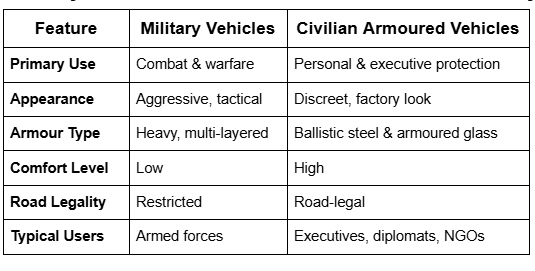
Military vehicles are designed for warfare and tactical dominance. Civilian armoured vehicles are built for personal, corporate, and diplomatic protection in urban and intercity environments.
2. Design & Appearance
Military vehicles look aggressive with their high ground clearance, exposed armour, and mounted hardware. Civilian armoured vehicles retain a factory-original appearance, making them ideal for low-profile security.
3. Level of Armour
Military vehicles can withstand heavy-calibre rounds and explosives. Civilian armoured vehicles are rated against specific ballistic threats, commonly handgun and rifle fire, depending on protection level.
4. Mobility & Comfort
Military vehicles sacrifice comfort for durability. Civilian armoured vehicles maintain air conditioning, infotainment, suspension comfort, and smooth handling.
5. Legal & Practical Use
Military vehicles are often restricted to defense forces. Civilian armoured vehicles are road-legal, registrable, and usable without special permits in most regions.
Military Vehicles vs Armoured Vehicles: Summary Table
About AAT ArmourTech
AAT ArmourTech specializes in civilian armoured vehicles engineered for real-world threats. From armoured SUVs and sedans to security and escort vehicles, AAT ArmourTech combines advanced ballistic materials, precision engineering, and discreet design.
Every vehicle is customized based on:
- Threat assessment
- Usage environment
- Performance and comfort needs
>> Discover how professional armouring is done right. Visit AAT ArmourTech to explore our solutions.
FAQs: Military Vehicles vs. Civilian Armoured Vehicles
1. Are civilian armoured vehicles bulletproof?
They are bullet-resistant, designed to stop specific ballistic threats based on their protection level.
2. Can civilians legally own armoured vehicles?
Yes, in most countries civilian armoured vehicles are legal and registrable.
3. Are military vehicles safer than civilian armoured vehicles?
In combat zones, yes. In civilian environments, military vehicles can increase risk due to visibility and escalation.
4. Do armoured vehicles look different from normal cars?
Professionally armoured civilian vehicles look almost identical to factory models.
5. Which vehicle is better for executive security?
Civilian armoured vehicles offer the best balance of protection, comfort, and discretion.