
When people hear the term “bullet proof vehicle,” they often imagine something indestructible; a machine capable of withstanding any attack. In reality, true protection is not about exaggeration. It is about engineering discipline, certified materials, and verified performance standards.
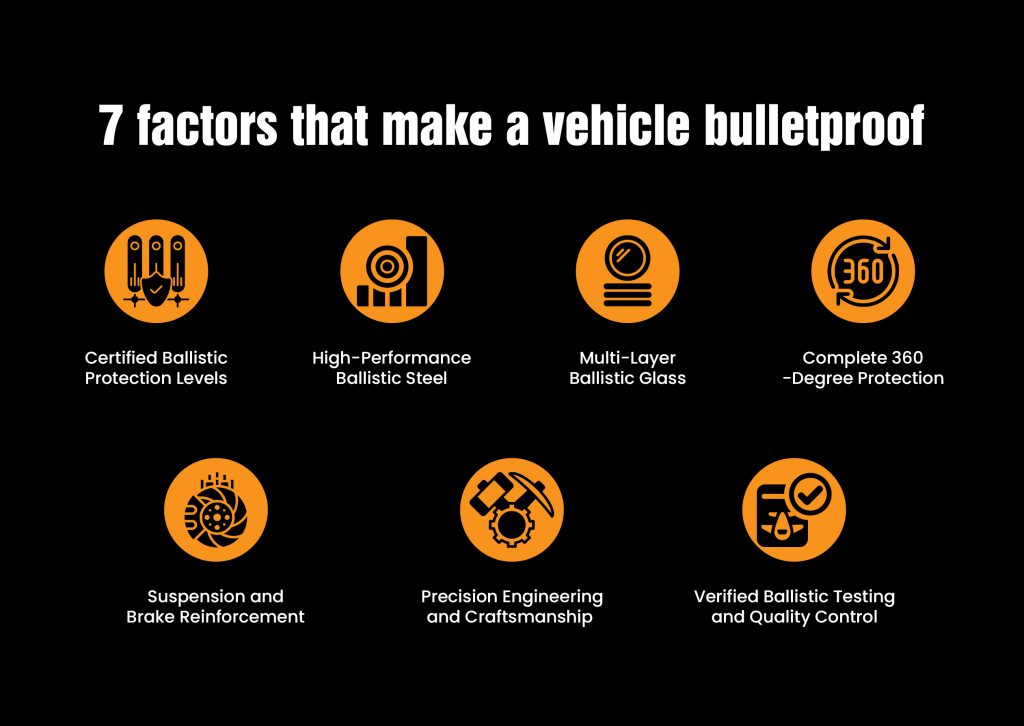
At AAT Armourtech, protection is never assumed, it is calculated. A truly bullet proof vehicle is the result of multiple integrated systems working together. Here are the seven factors that define whether a vehicle is genuinely built for ballistic resistance.
1. Certified Ballistic Protection Levels
The first and most important factor is certification. A vehicle cannot be considered truly bullet resistant unless it meets internationally recognized ballistic standards such as BR4, BR5, or BR6. These ratings specify the type of ammunition the vehicle can withstand, ranging from handgun rounds to high-powered rifles.
Without a certified rating, “bullet proof” becomes a marketing term rather than a measurable claim. True protection begins with knowing exactly what level of threat the vehicle is engineered to resist.
>> At AAT Armourtech, every conversion aligns with strict ballistic benchmarks, supported by documented testing procedures. You can explore more about verified testing here.
2. High-Performance Ballistic Steel
The foundation of any armoured vehicle lies in the steel. Standard automotive steel is not designed to absorb ballistic impact. Proper armouring requires hardened ballistic steel that can disperse projectile energy while maintaining structural integrity.
Equally important is how the steel is integrated. Panels must overlap strategically, pillars must be reinforced, and seams must be sealed to eliminate weak points. Even a small gap can compromise the integrity of the safety capsule. True bullet resistance is not about thickness alone, it is about intelligent placement and effortless coverage.
3. Multi-Layer Ballistic Glass
Ballistic glass is often the most visible component of an armoured vehicle, yet it is also one of the most technically advanced. It consists of multiple layers of hardened glass and polycarbonate bonded together to absorb and disperse impact energy.
The thickness of the glass varies depending on the protection level required. However, installation is just as critical as the material itself. The edges, frames, and sealing must be reinforced so that no vulnerable areas remain. When properly engineered, ballistic glass maintains clarity and visibility while delivering certified protection.
4. Complete 360-Degree Protection
True bullet proof engineering ensures that protection extends beyond doors and windows. The roof, firewall, rear compartment, pillars, and fuel tank area must all be reinforced to create a fully enclosed safety cell.
Many overlook the importance of underbody protection. Depending on the threat environment, reinforced flooring and blast-resistant materials may be integrated to protect against explosive risks. At AAT Armourtech, the goal is to build a continuous protective shell rather than isolated armour sections.
If you are considering different vehicle categories, explore available options here:
>> Related Post: Pros and Cons of Using Law Enforcement Trucks for Border and Highway Operations
5. Suspension and Brake Reinforcement
Armour significantly increases vehicle weight. Without mechanical upgrades, this added mass can affect handling, braking efficiency, and long-term durability.
A properly engineered bullet resistant vehicle includes upgraded suspension systems, strengthened door hinges, and enhanced braking components. These modifications ensure the vehicle maintains stability, maneuverability, and safety even after armouring. Protection should never compromise drivability.
6. Precision Engineering and Craftsmanship
Ballistic materials alone do not guarantee safety. The quality of installation determines whether the vehicle performs as intended. Poor welding, misaligned panels, or exposed seams can create vulnerabilities.
Professional armouring requires precision engineering so that the vehicle maintains its original aesthetics while integrating a hidden protective capsule. At AAT Armourtech, attention to detail ensures OEM-level finishing without visible structural compromise.
7. Verified Ballistic Testing and Quality Control
No armoured vehicle should rely solely on theoretical claims. Real ballistic testing validates performance under live-fire conditions. This confirms that materials and installation techniques perform according to certified standards.
How AAT Armourtech Delivers True Bullet Proof Standards
At AAT Armourtech, protection is engineered, not improvised. Each vehicle conversion is approached with a system-based methodology that integrates certified ballistic steel, multi-layer ballistic glass, structural reinforcements, and mechanical upgrades.
Whether armouring a luxury SUV, a business sedan, or a tactical pickup truck, the objective remains the same: deliver certified protection while preserving comfort, performance, and design integrity.
>> To explore complete armoured vehicle solutions, visit AAT ArmourTech today.
Frequently Asked Questions (FAQs)
1. Are bullet proof vehicles completely invincible?
No vehicle is completely invincible. Protection depends on the certified ballistic rating and the type of threat encountered.
2. What does a ballistic rating mean?
A ballistic rating specifies the type of ammunition a vehicle can resist, based on standardized testing protocols.
3. Does armouring affect fuel efficiency?
Yes, additional weight may impact fuel consumption, but proper engineering minimizes performance loss.
4. Can luxury vehicles be armoured without changing their look?
Yes. Professional armouring maintains the original appearance while integrating internal protection systems.
5. How can I verify if a vehicle is truly bullet resistant?
Request certification details and confirmation of live ballistic testing before purchasing.