
In 2026, buyers across security, private contracting, and fleet management sectors are reconsidering how they invest in protection-grade mobility. Among the options available, law enforcement vehicles, particularly decommissioned units, are gaining attention for their durability and cost advantage.
However, purchasing a used police or government fleet vehicle is not as straightforward as it may seem. While the price tag may look attractive, long-term value depends on condition, usage history, and intended application.
For businesses evaluating armoured vehicles or even upgrading into bullet proof vehicles, understanding the full picture is essential. Below, we explore the key advantages and potential drawbacks before making an informed decision.
>> Considering a used law enforcement vehicle? Speak with our experts to evaluate upgrade potential and protection options.
Why Buyers Consider Used Law Enforcement Vehicles
Police and government fleet vehicles are built for endurance. Unlike civilian cars, they are engineered to withstand extended idling, rapid acceleration, heavy-duty suspension use, and continuous operational cycles.
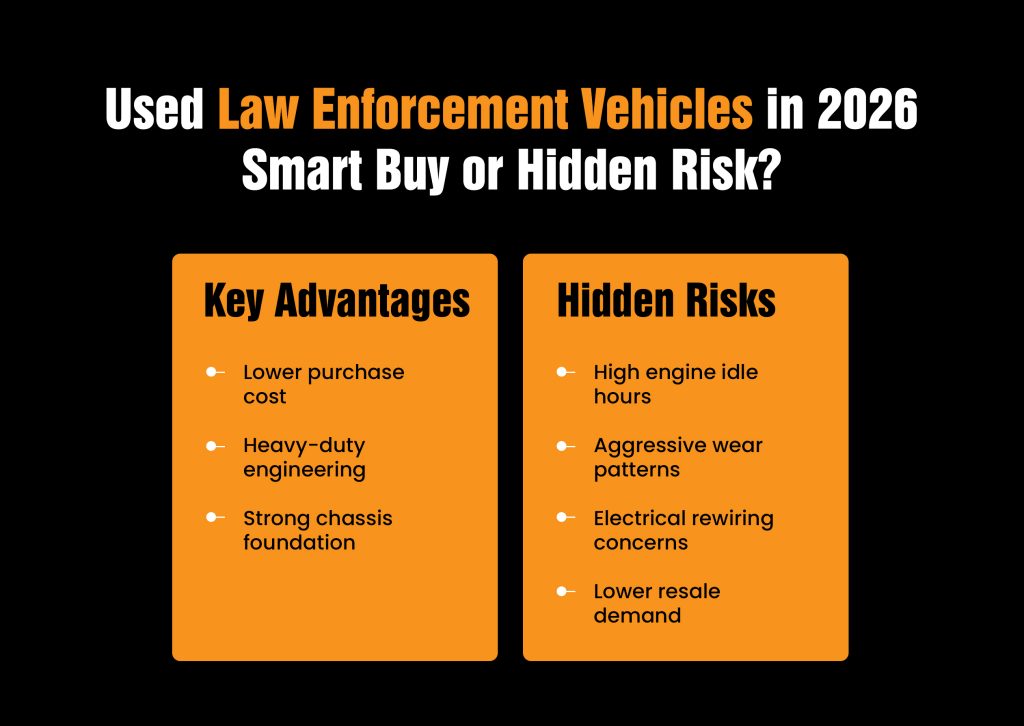
For buyers in 2026, this translates into three perceived advantages:
- Lower upfront cost compared to new tactical vehicles
- Heavy-duty mechanical components
- Reinforced chassis and upgraded braking systems
Fleet vehicles such as SUVs and pickup trucks often come with stronger alternators, cooling systems, and suspension packages designed for intense daily use. On paper, this makes them appealing for private security firms, industrial operations, and even rural mobility needs.
The Pros of Investing in Used Law Enforcement Vehicles
1. Cost Efficiency
The most obvious benefit is price. A decommissioned law enforcement vehicle can cost significantly less than a new SUV or tactical-grade platform. For startups, security contractors, or NGOs operating under strict budgets, this creates immediate financial flexibility.
In some cases, buyers can reinvest the cost savings into upgrading the vehicle, including converting it into discreet bullet proof vehicles where required.
2. Built for Heavy Duty Performance
Police vehicles are not driven lightly. They are designed to handle high-speed maneuvers, sudden braking, uneven terrain, and extended engine operation. This engineering often means a stronger drivetrain compared to civilian variants of the same model. For businesses operating in demanding environments, this can be beneficial.
3. Platform Potential for Armouring
Some fleet SUVs and pickups offer a solid base for armouring upgrades. Their reinforced suspension and chassis strength can support the additional weight associated with armoured vehicles, provided structural integrity remains intact. However, professional evaluation is critical before assuming compatibility.
>> Don’t compromise on safety. Discover professionally engineered armoured and bullet proof vehicles built for real-world threats.
The Cons of Buying Used Law Enforcement Vehicles
1. High Wear and Tear
Police vehicles may accumulate moderate mileage, but what matters more is operational intensity. Long idling hours, rapid acceleration, aggressive braking, and frequent stop-start cycles accelerate wear on engines, transmissions, and suspension systems.
Even if the odometer appears reasonable, internal mechanical stress may be significant.
2. Electrical System Modifications
Former law enforcement vehicles often contain modified wiring for sirens, radios, light bars, and communication equipment. After decommissioning, these systems are removed, sometimes leaving complex electrical adjustments behind. Improper restoration can create long-term reliability issues.
3. Reduced Resale Value
Because these vehicles have a known service history as police units, resale markets can be narrower. Buyers seeking civilian comfort may hesitate, affecting future liquidity.
4. Not Automatically Armoured
A common misconception is that police vehicles are inherently protected. Most are not ballistic-rated. They may have reinforced components, but they are not equivalent to certified bullet proof vehicles or factory-integrated armoured vehicles. Protection upgrades require professional engineering, not assumption.
Used Law Enforcement Vehicles vs. Purpose-Built Armoured Vehicles
In 2026, the security landscape is more complex than ever. Buyers must distinguish between durability and protection. A used patrol SUV may handle mechanical stress, but it does not provide ballistic resistance unless upgraded. In contrast, certified armoured vehicles are engineered with:
- Ballistic steel integration
- Multi-layer bullet-resistant glass
- Reinforced door pillars
- Run-flat systems
- Weight-compensated suspension
The difference lies in protection certification and threat mitigation. For organizations operating in higher-risk environments, investing in professionally engineered vehicles often provides greater long-term value than retrofitting high-mileage platforms.
>> Unsure whether to retrofit or invest new? Contact AAT ArmourTech for tailored advice on secure mobility solutions.
Law Enforcement Vehicles and Armoured Vehicles: How AAT ArmourTech Adds Value
When evaluating law enforcement vehicles, the real question is long-term security performance. AAT ArmourTech provides expert consultation to determine whether upgrading an existing platform is viable, or whether investing directly in certified vehicles is the smarter choice.
From ballistic integration to discreet reinforcement, AAT ArmourTech ensures that safety upgrades meet international standards without compromising structural integrity. Whether you are converting a platform or purchasing a ready-built solution, protection should never be improvised, it should be engineered.
FAQs
1. Are used law enforcement vehicles reliable?
They can be durable, but high operational stress may reduce remaining lifespan. A professional inspection is essential.
2. Do police vehicles come bulletproof from the factory?
Most do not. They are reinforced for durability but are not certified bullet proof vehicles unless specifically armoured.
3. Can a used patrol vehicle be converted into an armoured vehicle?
Yes, but structural condition must be evaluated to ensure it can safely support ballistic upgrades.
4. Are used law enforcement vehicles good for security companies?
They may suit low-risk operations, but higher-threat environments require certified armoured vehicles.
5. Is it better to buy new armoured vehicles instead?
For high-risk transport, professionally engineered armoured vehicles often provide better long-term protection and reliability.