
A brake system for armoured vehicles must be far more advanced than the standard braking components found in regular passenger vehicles. Without specialized braking systems, the additional weight of armour can increase stopping distances, overheat brake components, and compromise overall vehicle control. For security vehicles, military transport, and high-risk VIP protection vehicles, reliable braking is not optional, it is essential for safety and operational effectiveness.
In this article, we explore why standard braking systems are not sufficient for armoured vehicles and what makes specialized braking solutions critical for performance, safety, and durability.
>> Need a reliable brake system for armoured vehicles? Explore AAT ArmourTech’s advanced armouring solutions designed for maximum safety and performance. Contact our experts today.
The Weight Challenge in Armoured Vehicles
One of the most significant differences between standard vehicles and armoured vehicles is weight. Armour plating, ballistic glass, reinforced doors, and protective materials can add hundreds or even thousands of kilograms to a vehicle’s total mass.
For example, an SUV that normally weighs around 2,000 kg may weigh over 3,500 kg or more once it has been armoured. This increase directly affects the vehicle’s braking requirements.
When a vehicle becomes heavier, the braking system must generate much more force to slow it down. Standard factory brakes are engineered for the original vehicle weight, not the added mass of armour. As a result, using standard brakes on an armoured vehicle can lead to:
- Longer stopping distances
- Brake overheating during repeated braking
- Increased wear on brake pads and discs
- Reduced driver control in emergency situations
Why Standard Brakes Are Not Designed for Armoured Vehicles
Standard automotive braking systems are carefully designed for specific weight ranges and driving conditions. When armour is added, the original system may no longer operate within its safe performance limits. A typical braking system includes components such as brake discs, pads, calipers, hydraulic systems, and cooling mechanisms. In normal vehicles, these components are balanced to provide efficient stopping under everyday driving conditions.
However, once armour is installed, several problems can occur:
1. Heat Buildup
Heavier vehicles require more braking force, which generates more heat. Standard brake systems can overheat quickly when subjected to repeated braking under heavier loads. Excessive heat can cause brake fade, a condition where the brakes temporarily lose effectiveness. In high-risk situations, brake fade can be extremely dangerous.
2. Increased Mechanical Stress
Brake components must absorb enormous forces when stopping a heavy vehicle. Standard components may experience premature wear or mechanical failure when subjected to loads beyond their design limits.
3. Reduced Stopping Efficiency
A vehicle’s stopping distance increases as its mass increases. Without upgraded braking components, armoured vehicles may require significantly more distance to come to a complete stop. For security or tactical operations, delayed braking response can compromise both safety and mission effectiveness.
Key Components of a Specialized Brake System for Armoured Vehicles
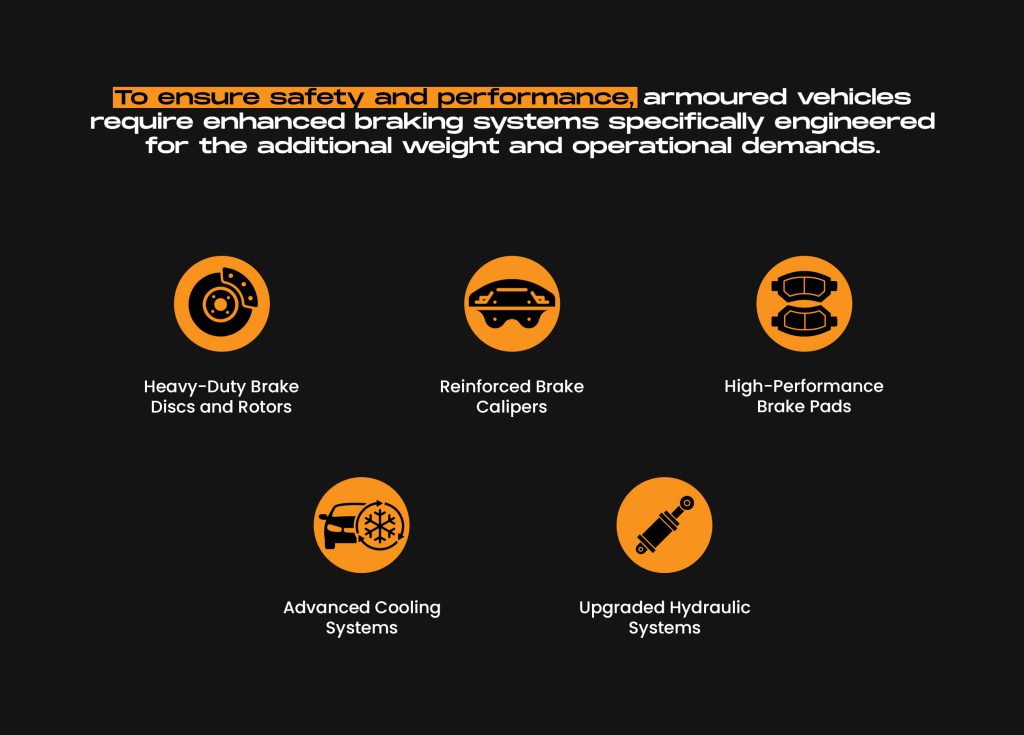
To ensure safety and performance, armoured vehicles require enhanced braking systems specifically engineered for the additional weight and operational demands.
Heavy-Duty Brake Discs and Rotors
Armoured vehicles use larger and thicker brake discs designed to handle greater heat and friction. These upgraded rotors improve heat dissipation and maintain braking performance during repeated use.
Reinforced Brake Calipers
Brake calipers apply pressure to the brake pads to slow the vehicle. In armoured vehicles, reinforced calipers provide stronger clamping force, ensuring the braking system can effectively stop the heavier vehicle.
High-Performance Brake Pads
Specialized brake pads are designed to operate at higher temperatures without losing effectiveness. These pads provide stronger friction and longer lifespan compared to standard automotive brake pads.
Advanced Cooling Systems
Heat management is critical for braking performance. Armoured vehicle brake systems often include improved ventilation and cooling features to prevent overheating during intense driving conditions.
Upgraded Hydraulic Systems
The hydraulic system transfers force from the brake pedal to the braking components. Upgraded hydraulic systems ensure that sufficient pressure is delivered to stop the vehicle quickly and safely.
The Importance of Brake Testing for Armoured Vehicles
Testing is an essential part of developing a reliable brake system for armoured vehicles. Engineers conduct extensive braking tests to evaluate stopping distances, heat tolerance, and component durability.
These tests simulate real-world scenarios such as emergency braking, downhill braking under heavy load, and repeated high-speed stops. The results help manufacturers determine whether the braking system can maintain performance under extreme conditions.
Without proper testing and engineering, even high-quality brake components may fail to deliver the required performance for armoured vehicles.
Brake Maintenance for Armoured Vehicles
Even the most advanced braking systems require regular inspection and maintenance. Because armoured vehicles operate under higher stress than standard vehicles, brake components may wear faster if not properly maintained.
Routine maintenance should include:
- Checking brake pad thickness
- Inspecting brake discs for wear or damage
- Monitoring brake fluid levels and quality
- Examining seals and hydraulic components
AAT ArmourTech and Reliable Brake System for Armoured Vehicles
At AAT ArmourTech, safety and performance are at the core of every armoured vehicle we build. Our engineering approach ensures that each brake system for armoured vehicles is specifically designed to handle the increased weight and operational demands of armoured protection.
Rather than relying on standard factory components, our vehicles are equipped with upgraded braking systems engineered for durability, reliability, and superior stopping power. These systems are carefully integrated with reinforced suspension and vehicle dynamics to maintain control even under demanding conditions.
Whether the vehicle is an armoured SUV, sedan, or specialized security transport, AAT ArmourTech prioritizes advanced braking performance to ensure maximum safety for passengers and drivers.
>> Looking for professionally engineered armoured vehicles? Discover how AAT ArmourTech integrates high-performance braking systems for superior control and protection. Get in touch with us today.
FAQs
1. What is a brake system for armoured vehicles?
A brake system for armoured vehicles is a reinforced braking setup designed to handle the additional weight of armour and provide safe stopping power under demanding conditions.
2. Why can’t standard brakes be used in armoured vehicles?
Standard brakes are designed for normal vehicle weight. Armoured vehicles are much heavier, which can cause overheating, longer stopping distances, and faster wear if standard brakes are used.
3. How does vehicle weight affect braking performance?
Heavier vehicles require more force to stop. This increases heat and stress on brake components, making specialized heavy-duty brakes necessary.
4. What components are upgraded in armoured vehicle braking systems?
Common upgrades include heavy-duty brake discs, reinforced calipers, high-performance brake pads, improved cooling systems, and stronger hydraulic components.
5. How often should armoured vehicle brakes be inspected?
Because of the increased load and stress, armoured vehicle brake systems should be inspected regularly as part of routine maintenance to ensure optimal safety and performance.