
In regions where security risks vary widely, from active conflict zones to urban executive travel, armoured vehicles play very different roles. While they may look similar from the outside, military vehicles and civilian armoured vehicles are designed for entirely different missions. Understanding these differences is essential for government buyers, corporations, NGOs, and private individuals evaluating protection options.
This guide breaks down both vehicle types independently, then clearly compares their key differences, so you can make informed decisions based on real-world use, not assumptions.
>> Related Post: What Are Armoured Vehicles and Who Needs Them in Pakistan?
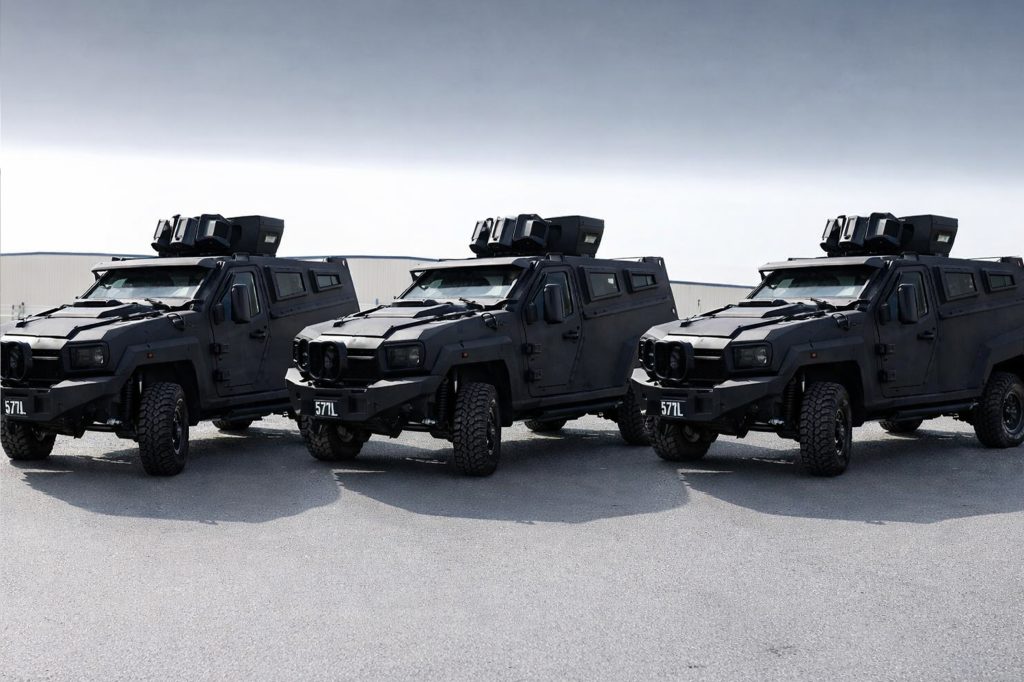
What Are Military Vehicles?
Military vehicles are purpose-built platforms designed for combat, troop movement, logistics, and tactical operations. They are engineered to operate in hostile environments where threats are continuous, unpredictable, and often extreme.
These vehicles are usually developed from the ground up or heavily modified military-grade platforms. Their design prioritizes maximum survivability and operational capability, often at the expense of comfort, road legality, or civilian usability.
Key characteristics include reinforced chassis, high ballistic and blast resistance, and the ability to withstand military-grade weapons. Many military vehicles also feature mine-resistant underbodies, weapon mounts, and advanced communication systems for battlefield coordination. Because of their weight and configuration, they are typically not suitable for everyday roads or civilian traffic.
Military vehicles are used by armed forces, peacekeeping units, and security agencies operating in active conflict zones. Their protection is designed to counter not just small arms fire, but also explosives, ambushes, and sustained attacks.
What Are Civilian Armoured Vehicles?
Civilian armoured vehicles are standard production vehicles, such as SUVs, sedans, vans, or buses, that have been discreetly reinforced for personal and corporate protection. Unlike military vehicles, these are designed to blend into everyday traffic while offering reliable defense against targeted threats.
These vehicles are commonly used by executives, diplomats, NGOs, cash-in-transit operators, and families in high-risk regions. The armouring process focuses on ballistic protection against handguns, rifles, and blast fragments, depending on the selected protection level.
Civilian armoured vehicles retain factory aesthetics and road legality. Comfort, drivability, and maintenance practicality are key priorities. Suspension, brakes, and drivetrain components are upgraded to handle additional weight, but without compromising daily usability.
Most importantly, civilian armoured vehicles are built to protect occupants during escape and evasion scenarios, not prolonged combat. Their role is to allow safe transit through risk-prone environments while remaining inconspicuous.
>> Learn more about civilian armouring solutions and available protection levels.
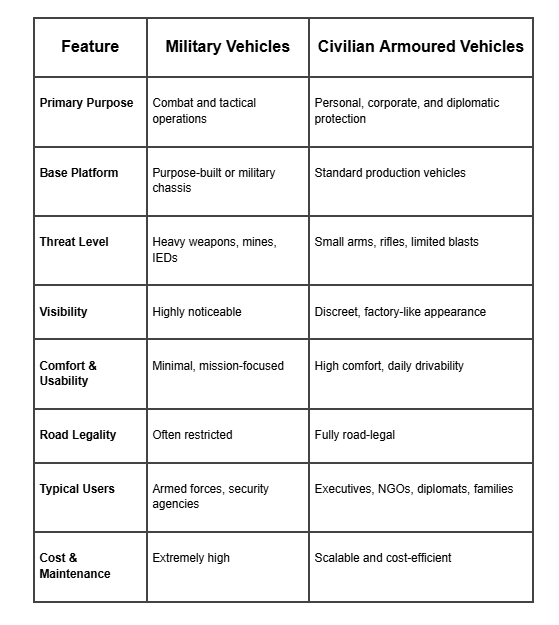
Core Differences Between Military and Civilian Armoured Vehicles
1. Design Philosophy and Mission Role
Military vehicles are engineered for battlefield dominance, where sustained engagement, mobility under fire, and mission continuity are critical. They are built to operate as part of coordinated military operations, often in extreme terrain and hostile environments.
Civilian armoured vehicles, by contrast, are designed around risk mitigation and safe mobility. Their primary objective is to protect occupants during targeted attacks and enable quick evacuation, not prolonged confrontation.
2. Threat Response and Protection Levels
Military vehicles are expected to withstand heavy weaponry, explosive devices, and repeated attacks. Their armour systems often include blast-resistant underbodies, reinforced hulls, and multi-layered protection capable of handling military-grade threats.
Civilian armoured vehicles focus on protection against small arms fire, rifles, and limited explosive threats, depending on the selected ballistic level. The emphasis is on surviving short-duration attacks long enough to escape the danger zone safely.
3. Visibility and Operational Discretion
Another critical difference lies in how these vehicles appear and operate in public spaces. Military vehicles are intentionally high-visibility and intimidating, often equipped with external armour, tactical fittings, and weapon mounts.
Civilian armoured vehicles prioritize discretion. They retain factory-like aesthetics and blend into normal traffic, which helps reduce attention and lowers the likelihood of becoming a target in the first place.
4. Regulation, Accessibility, and Legal Use
Military vehicles are highly restricted assets, typically limited to armed forces and government agencies. Their use, ownership, and deployment are tightly controlled and unsuitable for civilian road networks.
Civilian armoured vehicles, on the other hand, are road-legal, registerable, and insurable. They are designed to comply with civilian transport regulations, making them practical for everyday use in urban and intercity environments.
5. Cost Structure and Lifecycle Considerations
Cost is another major point of separation. Military vehicles involve extensive material usage, specialized systems, and long development cycles, resulting in very high acquisition and maintenance costs.
Civilian armoured vehicles are comparatively cost-efficient and scalable, as they are based on commercial vehicle platforms. Maintenance, servicing, and parts availability remain manageable within civilian automotive ecosystems.
>> Contact AAT ArmourTech for a consultation to determine the right armouring solution for your security requirements.
Choosing AAT ArmourTech For Your Armoured Vehicles
AAT ArmourTech is a specialized armoured vehicle manufacturer providing civilian and commercial armouring solutions tailored to real-world security needs. The company focuses on transforming standard vehicles into discreet, high-performance armoured platforms without compromising comfort, mobility, or reliability.
AAT ArmourTech offers customised armouring for SUVs, sedans, vans, and personnel transport vehicles, using certified ballistic steel, multi-layer bullet-resistant glass, and reinforced vehicle systems. Each project is engineered based on threat assessment, terrain conditions, and client usage, ensuring protection levels are neither excessive nor insufficient.
>> Explore AAT ArmourTech’s civilian armoured vehicle solutions and protection standards.
Frequently Asked Questions (FAQs)
1. Are military vehicles safer than civilian armoured vehicles?
Not necessarily. Military vehicles offer higher protection against extreme threats like explosives and heavy weapons, but they are not always safer for civilian use. Civilian armoured vehicles are specifically engineered to counter realistic urban threats while remaining discreet, road-legal, and easier to operate daily.
2. Can civilians legally own military vehicles?
In most countries, civilians cannot legally own or operate military vehicles due to strict regulations and export controls. Civilian armoured vehicles, however, are legally registered and insured, making them a practical alternative for personal and corporate security.
3. What level of protection do civilian armoured vehicles provide?
Civilian armoured vehicles typically offer protection against handguns, assault rifles, and blast fragments, depending on the selected ballistic level (such as B4, B6, or B7). The protection level is chosen based on threat assessment and usage environment.
4. Do civilian armoured vehicles look different from normal cars?
No. One of the key advantages of civilian armoured vehicles is their low-profile appearance. They are designed to look like standard factory vehicles, helping occupants avoid unnecessary attention and reducing security risks.
5. How do I choose between military-grade and civilian armouring?
The choice depends entirely on threat level, environment, and purpose. Battlefield or tactical operations require military vehicles, while executive transport, NGO missions, and private security are best served by civilian armoured vehicles. A professional threat assessment is essential before making a decision.
One Response