
The question organizations are increasingly asking is not whether to invest in bulletproof vehicles for NGOs, but which platform actually fits the mission, the terrain, and the team.
Aid workers do not get to choose where threats exist. They go where crises are, into flood-affected regions, conflict corridors, and areas where state authority is limited. In Pakistan, field teams regularly operate in Balochistan, KP, and the tribal belt, where the road between a relief camp and the nearest checkpoint can be among the most dangerous stretches a person will ever drive.
>> Related Post:Armoured Upgrades for Toyota Hilux in Pakistan: What You Need to Know
Why Bulletproof Vehicles for NGOs Have Become a Field Standard
There was a time when armoured transport was considered excessive for humanitarian operations. That thinking has not survived contact with field reality.
The International Institute for Strategic Studies documented a 37% increase in deaths from violent incidents globally between mid-2023 and mid-2024, and aid organizations are operating directly inside those numbers. Their visibility, logos, predictable routes, high-profile schedules, can make them easier targets rather than harder ones. Many organizations have already responded. The bulletproof armoured vehicle market is projected to rise from USD 14.41 billion in 2025 to USD 15.69 billion in 2026, growing at a CAGR of 8.9%, with NGOs, diplomatic missions, and civilian field teams among the fastest-growing end-user groups.
The Real Cost of Sending Field Teams Out in Unarmoured Vehicles
Most organizations start with standard 4x4s. They are familiar, serviceable, and cost-effective on paper. But in environments where armed robbery, carjacking, and targeted incidents against aid convoys are documented risks, an unarmoured vehicle is a liability your team is sitting inside every single day. Bulletproof vehicles for NGOs exist to provide one thing that no standard vehicle can: the ability to keep your people alive and mobile long enough to get out of a threat situation. That is not a product feature. That is the mission.
>> Is your NGO fleet equipped for Pakistan’s real field conditions? Contact AAT ArmourTech today and get a tailored protection assessment before your next deployment.
What Bulletproof Vehicles for NGOs and Aid Organizations Must Be Built to Do
Not every vehicle marketed as armoured is built for field reality. A vehicle that looks protected and a vehicle that performs under fire in a remote location are two entirely different things. Here is what separates a certified build from a cosmetic one.
Protection Standards That Actually Matter for NGO Armoured Vehicles
When evaluating armoured vehicles for aid organizations, protection ratings are the foundation. B6 covers resistance against high-powered rifle fire and represents the operational minimum for most field environments across South Asia and the Middle East. B7 goes further and is typically warranted only in the highest-threat contexts such as active conflict zones or operations involving senior diplomatic personnel.
What matters more than knowing the labels is insisting on independent third-party certification confirming the rating. A supplier who cannot produce that documentation is not a supplier worth engaging.
The Features Every Armoured Vehicle for Aid Organizations Needs in the Field
Run-Flat Mobility Systems
Losing a tire in a hostile environment is not an inconvenience. It is a crisis. A properly installed run-flat system keeps the vehicle operational at speed even after tire damage, which is non-negotiable on any remote NGO route where support is hours away.
Suspension and Brake Engineering
Ballistic materials add significant weight to a vehicle. Without purpose-built suspension and braking upgrades to match, that weight degrades handling, shortens component life, and reduces stopping reliability. A properly engineered armoured vehicle addresses this at the build stage, not as an afterthought.
Ballistic Glass Across Every Pane
Multi-hit resistant glass across all windows, not just the windscreen. A single point of failure in the glazing makes every other protective measure irrelevant. The glass must hold under repeated impact without shattering and without compromising the driver’s sightlines.
GPS Tracking and Communication Integration
Real-time route monitoring allows security coordinators to track convoy positions, anticipate threats ahead of the vehicle, and direct fast response. In Pakistan’s more volatile environments, the intelligence value of situational awareness before a threat materializes is significantly greater than any reactive capability.
>> Related Post: Run Flat System in Armoured Vehicles: Why It’s Non-Negotiable
Best Bulletproof Vehicles for NGOs: Platforms That Perform in the Field
Selecting the right platform is about matching engineering to mission, not choosing the most impressive vehicle on a spec sheet. These are the three platforms most commonly deployed by NGOs and aid organizations in high-risk environments.
Toyota Hilux: The Most Deployed Bulletproof Vehicle for NGO Field Teams
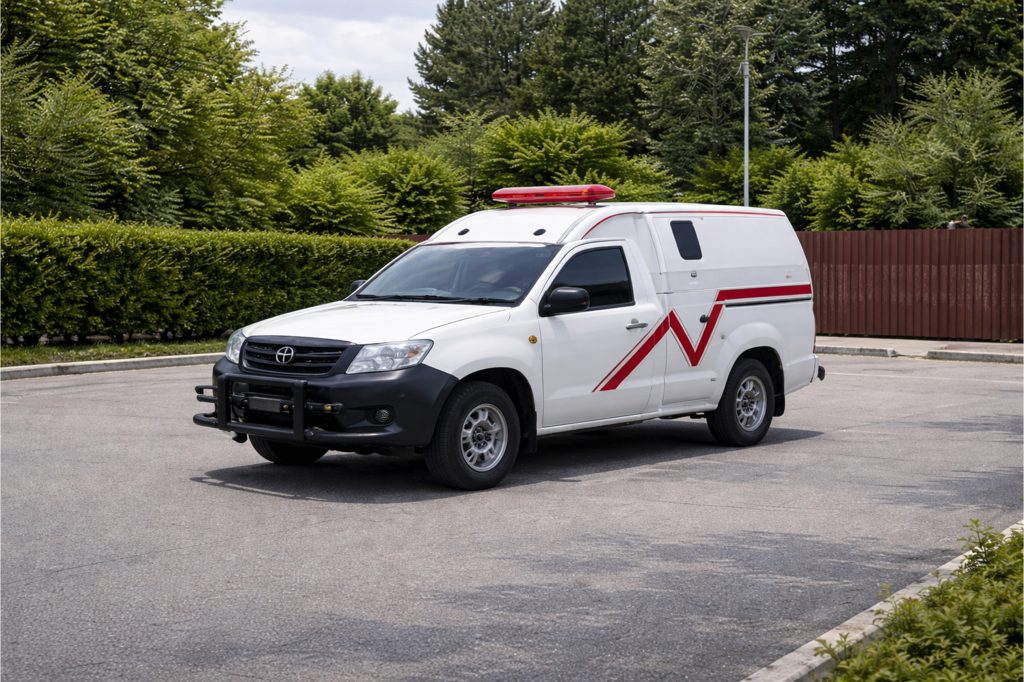
The Hilux is the global standard for NGO field operations, and its presence across conflict and post-conflict zones is not accidental. Its ladder-frame construction handles the additional load of armouring exceptionally well, its drivetrain is proven across decades of rough-terrain use from the Sahel to the mountains of KP, and parts availability across Pakistan is among the best of any platform in the market.
An armoured Hilux built to certified ballistic standards provides full protection while preserving the cargo capacity and terrain capability that field teams depend on daily. It carries equipment, accommodates crew, and handles road conditions that would stop any sedan or lighter SUV. For organizations running supply or assessment missions into remote areas, nothing fits the brief better.
Toyota Land Cruiser and Prado: Bulletproof Vehicles for NGO Convoy Operations
When the mission involves inter-city convoy movements, liaison roles, or transporting senior personnel through high-risk corridors, the Land Cruiser is the benchmark platform. Its chassis, drivetrain reliability, and parts availability across Pakistan make it the most trusted vehicle for organizations that need consistent protection over long distances and demanding schedules.
For convoy lead vehicles, principal protection, or any role that requires a vehicle to sustain heavy operational use while maintaining ballistic integrity, the Land Cruiser and Prado remain the most widely chosen platforms in the region.
Armoured Sedans: Bulletproof Vehicles for NGOs Requiring Operational Discretion
Not every operation benefits from a visible high-profile convoy. For senior NGO staff moving through Karachi, Lahore, or Islamabad on a daily basis, an armoured sedan provides full certified protection without signalling that a high-value individual is inside. It moves through city traffic without drawing scrutiny, which in many urban threat environments is itself a meaningful security advantage.
For organizations where operational security requires low visibility as much as physical protection, a properly built armoured sedan is often the more strategic choice.
>> Related Post: Top 5 In-demand Categories of Armoured Vehicles in Pakistan
How AAT ArmourTech Builds Bulletproof Vehicles NGOs and Aid Organizations Can Depend On
When the vehicle your team is riding in is the last line of protection, the supplier behind the build matters as much as the vehicle itself. AAT ArmourTech builds every armoured vehicle entirely in-house at their Islamabad facility. One team, one facility, full accountability at every stage of the build.
Every vehicle is certified to internationally recognized ballistic standards, with full documentation covering material test logs, certification reports, and component sourcing records. The global bulletproof vehicle market is estimated at USD 9.34 billion in 2026 and is projected to reach USD 13.46 billion by 2032 at a CAGR of 6.06%, and organizations investing in this space are raising their expectations for supplier accountability. AAT ArmourTech meets that bar with documentation for every vehicle delivered.
From armoured pickup trucks for field teams to armoured SUVs for convoy protection, every platform is fully customizable to the specific mission. After-sale service is provided for the life of the vehicle, because a vehicle that is not maintained cannot be trusted when it matters.
>> Your people go into high-risk environments so others do not have to. Make sure the vehicle they are in is built to bring them back. Request a quote from AAT ArmourTech.
FAQs: Bulletproof Vehicles for NGOs and Aid Organizations
1. Why do NGOs specifically need bulletproof vehicles?
NGOs operate in environments where armed robbery, carjacking, and targeted attacks on aid convoys are documented risks. Standard vehicles offer no meaningful protection in these scenarios. Bulletproof vehicles keep occupants protected and the vehicle mobile through a threat situation, which is the single most important capability in a high-risk field environment.
2. What ballistic protection level do most NGO armoured vehicles need?
B6 is the appropriate standard for most NGO field operations. It covers high-powered rifle fire, which represents the most common threat profile in humanitarian environments. Organizations operating in active conflict zones may require higher specifications based on a documented threat assessment.
3. Which vehicle platform is best suited for NGO field operations in Pakistan?
The Toyota Hilux is the most recommended platform for field teams. The Land Cruiser is preferred for inter-city convoy operations. For organizations with primarily urban footprints, an armoured sedan provides effective protection with a lower profile.
4. What documentation should we request when procuring bulletproof vehicles for NGOs?
Independent third-party certification reports for every ballistic component, material test logs, and component sourcing records. Any supplier who cannot produce this on request should not be trusted with a procurement of this importance.
5. Are armoured vehicles legal for NGO use in Pakistan?
Yes. Armoured vehicles are legal in Pakistan and are regularly operated by NGOs, diplomatic missions, and corporate security teams. Confirming applicable regulatory requirements with local legal counsel before procurement is advisable.
6. How does armouring affect vehicle performance in the field?
A properly engineered build maintains operational performance because suspension, braking, and drivetrain components are all upgraded to compensate for the added weight of ballistic materials. A vehicle where only armour has been added without matching engineering upgrades will suffer degraded handling and reduced reliability in the field.
7. What is a run-flat system and why is it essential for NGO vehicles?
A run-flat system allows a vehicle to continue operating at speed even after tire damage. For NGO teams on remote routes far from rapid-response support, this capability determines whether a vehicle performs in the exact scenario it was bought for.
8. How long does procurement and build take?
A standard armoured build typically takes four to eight weeks from order confirmation to delivery. Custom configurations will extend that timeline. Organizations with fixed deployment schedules should plan procurement well in advance.
9. Should an NGO rent or purchase armoured vehicles?
Rental suits short-term deployments. For NGOs with ongoing field presence in Pakistan, purchase provides better long-term value, consistent availability, and the ability to configure the platform precisely to recurring operational needs.
10. Why choose AAT ArmourTech for NGO armoured vehicle requirements?
AAT ArmourTech builds every vehicle in-house, certifies every build to internationally recognized standards, and provides full documentation on delivery. Every platform is customizable and backed by lifetime after-sale service, ensuring the vehicle stays reliable throughout its operational life.