
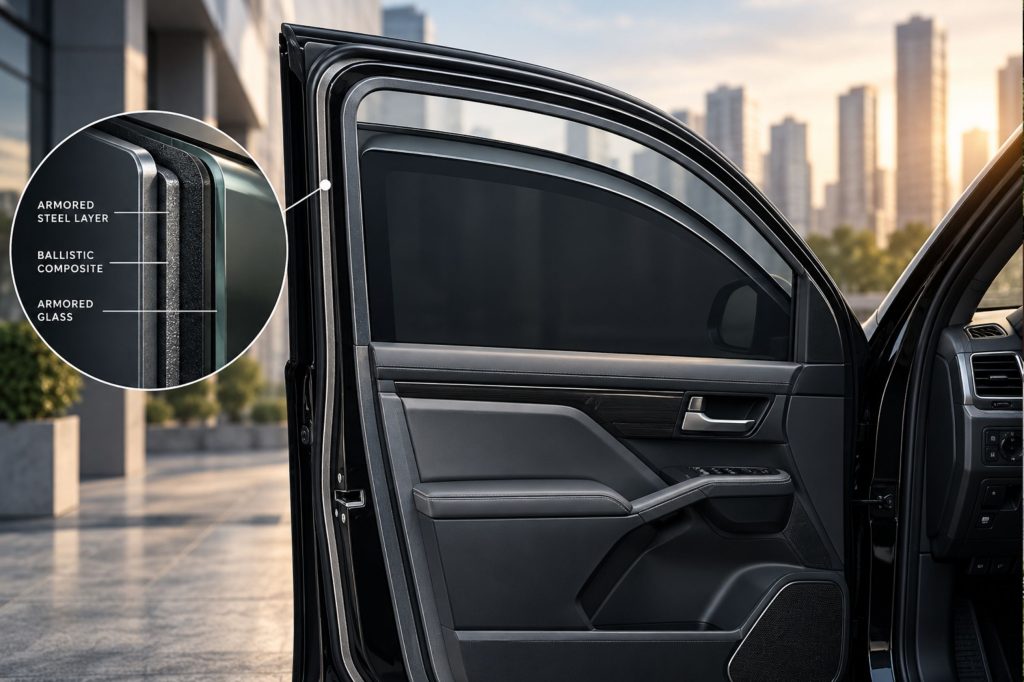
B6 vs B7 can sound like a simple protection choice. However, the label alone cannot determine whether a vehicle suits an actual protection assignment. Security managers must match the vehicle, route, passenger profile, and stated threat requirement before choosing an armour level.
The wrong comparison often focuses only on thicker materials. A proper decision also examines glass, overlap coverage, mobility systems, payload, and documentary testing evidence. This matters when evaluating an armoured Toyota Hilux Revo, Toyota Land Cruiser Prado, Toyota Fortuner, or Toyota Land Cruiser 79.
B6 vs B7 Starts With a Clear Threat Assessment
B6 vs B7 armouring should begin with a written threat assessment. The assessment should identify expected weapons, attack direction, travel pattern, and extraction requirements. It should also separate routine executive transport from higher-risk security deployments.
Market research lists B6 and B7 as separate ballistic-protection levels. The bulletproof armoured vehicle market was projected to reach USD 9.69 billion by 2034. That projection does not establish which level any Pakistani buyer needs.
Start with the assignment rather than the badge
A VIP movement plan may require discreet appearance and predictable handling. A security escort may instead prioritise passenger capacity and equipment space. These needs can lead to different platform choices before protection construction begins.
Record the threat assumptions for later review
Buyers should ask the supplier to document the proposed threat basis. This record supports future maintenance, fleet changes, and insurance discussions. It also prevents assumptions from being confused with verified performance.
>>Related Post: B6 Vs B7 Armouring
What Does a Properly Built B6 vs B7 Vehicle Actually Include
A B6 vs B7 comparison must cover the complete passenger cell. Vehicle armour involves more than visible door panels and window thickness. Buyers should examine protection continuity around seams, pillars, floors, roofs, and other body transitions.
Ask how the stated rating connects to recognised testing frameworks. Relevant vehicle and glazing references can include EN 1522, EN 1063, and UL 752. STANAG 4569 applies to specified military threat contexts and should not be assumed for civilian armouring.
- The exact protection scope proposed for each vehicle area.
- The glazing specification and its stated test reference.
- The method used to address panel overlaps and openings.
- The mobility equipment included after a tyre-related incident.
Glazing needs the same scrutiny as opaque armour
Ballistic glass affects visibility, window operation, and overall vehicle mass. Buyers should request the glazing specification in writing. EN 1063 and UL 752 are relevant standards to identify when reviewing glass documentation.
Protection gaps can undermine a strong material choice
Doors, pillars, firewall areas, and roof interfaces require deliberate integration. A stated material level alone does not describe those interfaces. Request an explanation of how the converter addresses continuity across the protected cell.
Mobility equipment supports a safe departure
A run flat system can support mobility after tyre damage. It does not replace ballistic protection or defensive driving procedures. Buyers should confirm the proposed system matches the tyre size and expected operational load.
>> Discuss your route profile, passenger requirements, and protection scope with our technical team.
Vehicle Weight Changes the B6 vs B7 Decision
The B6 vs B7 decision affects more than ballistic materials. Added mass can influence braking, suspension response, tyre loading, and usable payload. Therefore, the selected platform must suit the required protection package and operating pattern.
The global market was estimated at USD 15.69 billion in 2026. That wider demand does not remove the need for platform-specific engineering. Each completed vehicle requires its own weight and performance review.
Select the platform around the real operating role
A Toyota Hilux Revo can support a different operational layout than a Toyota Land Cruiser Prado. A Toyota Fortuner has different passenger and cargo considerations than a Toyota Land Cruiser 79. The base vehicle should be chosen before assuming the same package fits every model.
Suspension and brakes need an integrated review
Armoured vehicle performance and weight should be discussed as one engineering question. Buyers should ask how the proposed conversion considers suspension for bulletproof vehicles. They should also review the brake system for armoured vehicles before acceptance.
Payload remains important after conversion
Passengers, communications equipment, medical kits, and luggage all add operating weight. Security teams should calculate their normal deployment load. This helps prevent a vehicle from being specified around an unrealistic empty condition.
>>Related Post: Armoured Vehicle Performance And Weight
Questions to Ask Before Committing to a B6 vs B7 Build
A B6 vs B7 proposal should be assessed through evidence, not terminology alone. Ask for the exact scope, applicable standard references, and records for the proposed conversion. If a claim cannot be documented, treat it as [NEEDS CONFIRMATION].
A responsible review also covers future servicing and handover requirements. Replacement glass, tyres, brakes, and suspension components require an ownership plan. Buyers should clarify service responsibilities before placing an order.
- Which standard reference applies to each stated ballistic component?
- What areas are included within the proposed protection scope?
- What vehicle systems require altered servicing after conversion?
- What documentary evidence is available at handover?
Testing language should be specific and traceable
Ask whether the supplier can identify the relevant test reference and test conditions. Ballistic testing should describe the tested component and its configuration. A general statement about being bulletproof is not equivalent to a documented scope.
Compare total operating requirements rather than labels
The correct option depends on the threat assessment and operating environment. It also depends on vehicle condition, crew needs, and maintenance capacity. This approach is more useful than treating B6 and B7 as automatic buying tiers.
>> Request a technical review before selecting an armour level or vehicle platform.
Why AAT ArmourTech Gets B6 vs B7 Armouring for Pakistani Security Buyers Right
A protection decision should be supported by a clear scope, practical vehicle selection, and documented questions. AAT ArmourTech can help buyers assess those requirements before a conversion decision. Buyers should also review the company background and support approach through AAT ArmourTech. A careful review helps align the selected vehicle with the actual security assignment.
>> Share your protection requirement for a technical discussion of suitable vehicle options.
FAQs
1. What does B6 vs B7 mean for an armoured vehicle buyer?
B6 vs B7 is commonly used to compare vehicle ballistic-protection levels. Buyers should not rely on the label alone. They should request the stated threat scope, applicable standard references, and supporting documentation.
2. Is B7 always the right choice over B6?
No. The appropriate choice depends on the documented threat assessment and vehicle role. Higher protection requirements can affect weight, payload, handling, and service needs.
3. Which standards should I ask about in a B6 vs B7 proposal?
Ask which references apply to the quoted scope. EN 1522 may be relevant for ballistic-resistance classification, while EN 1063 and UL 752 may be relevant for glazing. STANAG 4569 applies to specified military contexts.
4. Does NIJ Level IV describe vehicle armour?
No. NIJ Level IV rates personal body armour, not vehicle armour. It may be relevant when discussing occupant body armour, but it is not a vehicle ballistic rating.
5. Does bulletproof glass determine the whole vehicle rating?
No. Bulletproof glass is one part of an integrated protection package. Buyers should also ask about opaque armour, overlaps, pillars, roof areas, floors, and protected openings.
6. Can an armoured Toyota Hilux Revo be assessed using the same criteria as an SUV?
The assessment principles remain useful, but each platform has different operating considerations. An armoured Toyota Hilux Revo should be reviewed for payload, intended equipment, passenger needs, and suspension requirements.
7. Why are run flat tyres relevant to a B6 vs B7 comparison?
Run flat tyres or a run flat system can support continued movement after tyre damage. They do not create ballistic protection. The proposed system should suit the completed vehicle weight and tyre specification.
8. What documents should be requested before accepting an armoured vehicle?
Request the quoted protection scope, component specifications, standard references, and available testing evidence. Also request maintenance information for modified systems. Missing documents should be marked [NEEDS CONFIRMATION].
9. How does vehicle weight affect a bulletproof Prado or Fortuner?
Added armour can affect braking, suspension response, tyre loading, and payload. A bulletproof Prado or bulletproof Fortuner should be evaluated around its expected passenger and equipment load, not an empty vehicle condition.
10. Should a buyer compare suppliers before selecting B6 or B7?
Yes. Compare the documented scope, engineering explanation, standards references, service plan, and evidence offered by each armoured vehicle supplier. This provides a stronger basis than comparing labels alone.